WORKSHOP NEWS
Complex Systems and Networks: Discussions Continued in the Ancient City of Modern Complexity
The 2010 International Workshop on Complex Systems and Networks (IWCSN2010) took place in Beijing on September 25-27, 2010: http://cscn.amss.ac.cn/iwcsn2010/ This workshop was the seventh in a successful series of events organized consequently in Bologna (2004), Hong Kong (2005), Vancouver (2006), Guilin (2007), Canberra (2008) and Bristol (2009). A collective website for this series of workshops is http://iwcsn.eie.polyu.edu.hk/
This year’s workshop focused on complex systems and complex networks, multi-agent systems, systems biology, sensor networks, communication networks, networked control systems, and their applications. This workshop was sponsored by the IEEE Circuits and Systems Society and its Nonlinear Circuits and Systems Technical Committee, the Centre for Chaos and Complex Networks at the City University of Hong Kong, the Research Centre for Complex Networks of Wuhan University, the China Center of Advanced Science and Technology, and the Beijing Jiaotong University, and was sponsored and hosted by the Academy of Mathematics and Systems Science, Chinese Academy of Sciences at Beijing, China.
Following the past successful workshop series, the two-day rich program was very well received, with a large set of inspiring lectures delivered by a group of distinguished speakers. About 100 researchers and students attended the workshop.
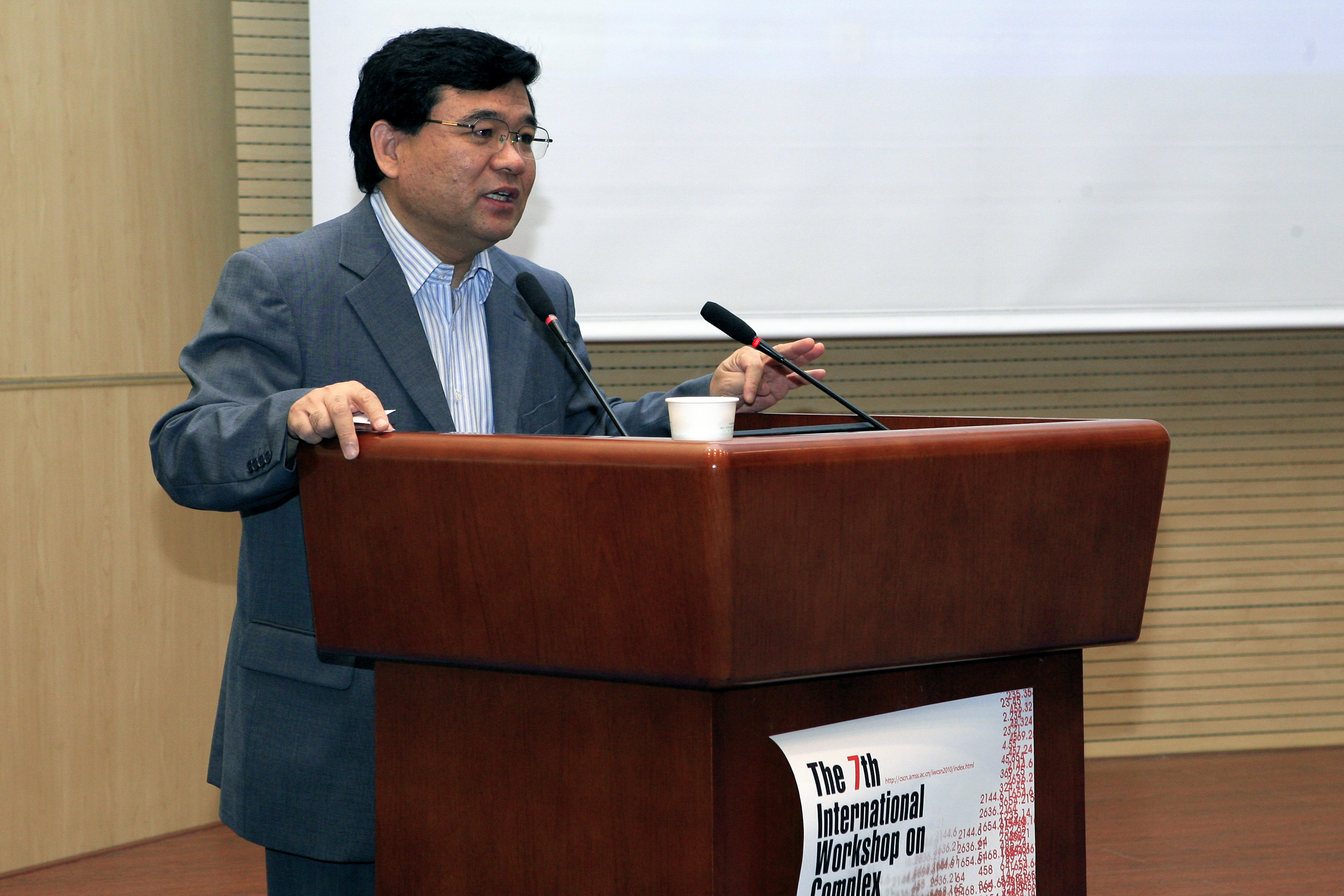
On the first day, Lei Guo (Chinese Academy of Sciences) opened the workshop with an exciting lecture on a theory of game-based control systems. Then, David Hill (Australian National University) addressed networked control of large-scale power networks. Furthermore, Michael Tse (Hong Kong Polytechnic University) and Xinghuo Yu (RMIT University) explored potential real-world applications of complex networks in stock markets and smart grids, respectively, followed by Mario di Bernardo (University of Bristol and University of Naples) who reported the recent research advances of his group, as well as some others, in synchronization and control of evolving dynamical networks, and by David Walker (University of Melbourne) who presented an application of the complex network modeling approach and methodology to the study of structural granular materials.
Prof. Guo Lei of the Academy of Mathematics and Systems Science, Chinese Academy of Sciences, giving his opening address and lecture
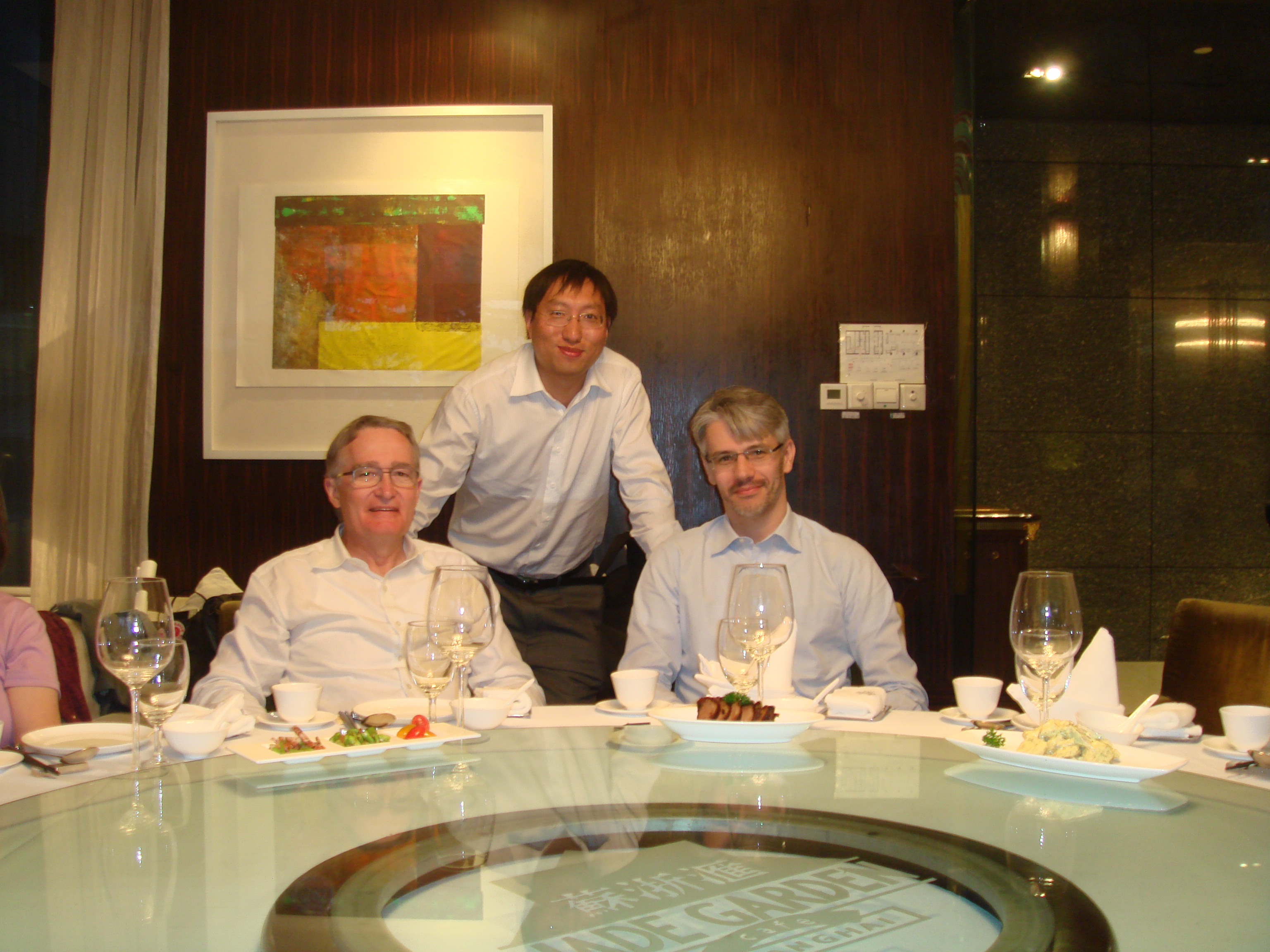
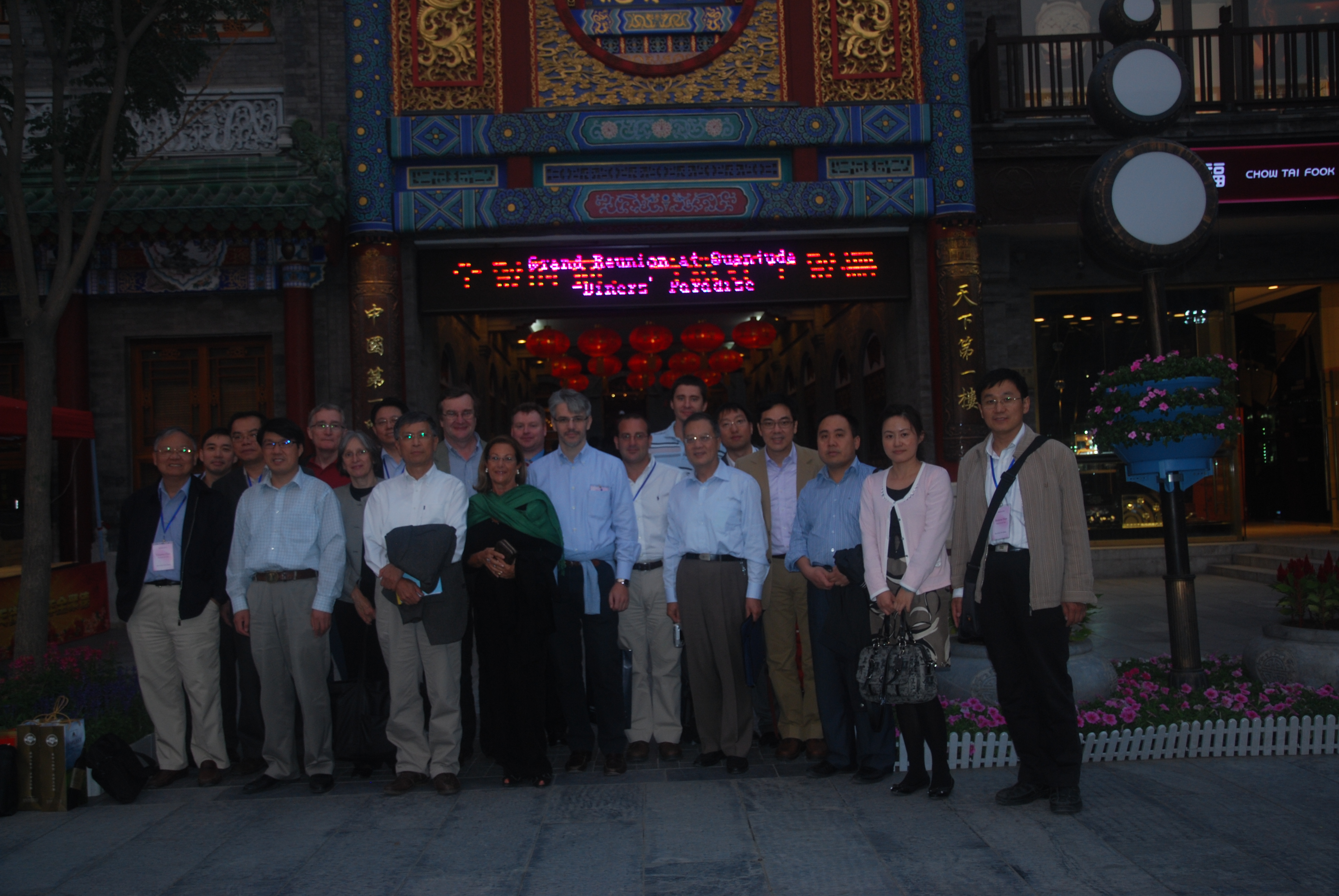
During the meeting a social dinner was held on the first day at Quanjude Quanmen Restaurant, a famous Chinese restaurant known for its trademark Peking Roast Ducks and its longstanding culinary heritage since its establishment in 1864 in Beijing, China. On the last day of the workshop program, part of the invited speakers visited the Forbidden City, the Temple of Heaven, and some historical Beijing Hutongs. Organizers and speakers at the historic Peking Ducks Restaurant, Quanjude
The IWCSN workshop series will continue its next meeting in Melbourne, Australia, in 2011. Details to be announced.
Jinhu Lü (jhlu@iss.ac.cn), Chinese Academy of Sciences, Beijing