


Obituary
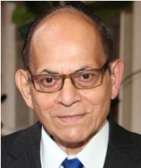
After marrying Isabel Colaço, also of Goa, in 1961, Rui moved to the United States, accepting a position at Purdue University. In 1965 he moved to Houston, Texas, where he was a Professor of Electrical Engineering and Mathematical Sciences at Rice University for 25 years. In 1990, he accepted a position as Professor of Electrical and Computer Engineering and Professor of Mathematics at the University of California, Irvine, and served as a researcher and teacher there until his retirement in 2007.
Rui is best known for his pioneering contributions to the mathematical foundations of linear and nonlinear problems in pattern recognition, signal and image processing, and neural networks, which, in turn, led to the development of novel methodologies for a wide range of applications. His work supported a variety of NASA space exploration projects, assisted the Department of Defense in weapons detection systems, helped companies identify credit card fraud, assisted the Environmental Protection Agency in oil spill detection and source matching, developed algorithms for more efficient transmission of mobile telecommunications signals, enhanced geophysical images for well-logging, and improved the early detection of brain and neural diseases, like Alzheimer’s disease. The results of his work can be found in over 400 scientific publications he authored.
While educating thousands of undergraduate and graduate students during his nearly 60-year career, he also won many awards and accolades for his research and teaching through university and professional organizations. He edited numerous journals, was named a Life Fellow by the Institute of Electrical and Electronics Engineers (IEEE), served as President of the IEEE Circuits and Systems Society and won the Kaptiza Medal, Chilingar Medal, the Ch. Asachi Medal, and the IEEE Mac Van Valkenburg Award for his seminal contributions to the field of electrical engineering.
He is survived by his wife of 52 years, Isabel; daughter Alcina Dalton and her husband Jim of Atlanta, Georgia; son Paul and his wife Kathy of College Station, Texas; son John and his wife Bronwyn of Chapel Hill, North Carolina; son Rui Jr. and his wife Natalia of Piedmont, California; and son Miguel and his wife Margaret of San Francisco, California; along with twelve loving grandchildren who fondly remember their grandfather as a generous man with a superb sense of humor who enjoyed expanding their horizons in mathematics, music, and current events. He is also survived by two brothers and numerous brothers-in-law, sisters-in-law, nephews, and nieces.
In lieu of flowers, the family asks that donations be made to the IEEE Life Members Fund at www.ieee.org/donate; or to Catholic Charities of Orange County, California at www.ccoc.org.

So Long, Rui
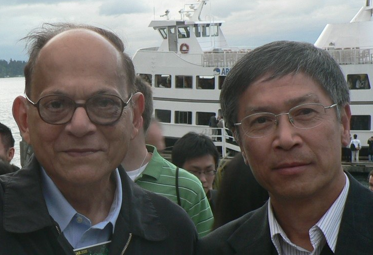
Rui de Figueiredo and Ron Chen at IEEE ISCAS’08, Seattle
Rui, you might remember College Station is the very place where I got your first phone call in the spring of 1987, which completely changed my life and career. “Hello, Ron Chen? Howdy!” To me, it was a surprising call in a sweet voice from a stranger mimicking an Aggie. “I read your two recent papers and found that they matched quite well with my current research projects. Would you like to come to Rice University to work with me as a post-doctoral fellow?” Well, you got your expected answer: Yes!
I remember my first question for you was something like, you are Indian but how come you have a Portuguese name? You smiled, and then explained. You were born in Panjim, Goa, India in 1929, which was a small Portuguese overseas territory beginning in the early 16th century for about 450 years until it was annexed by India in 1961.
With your support to the start of my academic career, I was appointed Visiting Assistant Professor in Electrical and Computer Engineering after one year of my arrival to Rice. Through my three years of association with you at Rice, I gradually learned more about you and your past, which garnered me a lot of respect to you – both as an established academic as well as an amazing human being. I learned that even in earlier ages, you had already demonstrated your high talents, not only musically – opting to turn down the admission to piano studies at Trinity College of Music in London, but also academically – choosing instead to attend MIT in Boston for your undergraduate and later graduate studies in electrical engineering. That fairy tale went back to year 1947.
Afterwards, Rui, I learned that during your graduate studies at MIT, you took time off to visit your family in Lisbon, Portugal, where you started research with the Portuguese Atomic Energy Commission using the experimental nuclear reactor located in Sacavem. A few years later you returned to Boston and completed your PhD degree in Applied Mathematics from Harvard University in 1959. You then returned to Portugal again, where you served as the head of the Applied Mathematics and Physics Division of the Portuguese Atomic Energy Commission, representing Portugal as a diplomat and technical expert to deal with scientific and business duties in national as well as international affairs.
Rui, your wife Isabel told me that you two got married in 1961 and then moved back to the USA together, where you accepted a tenured position as an Associate Professor in the School of Electrical Engineering at Purdue University. In 1965, you and your family moved to Houston, Texas, where you became a jointly appointed Full Professor of Electrical Engineering and of Mathematical Sciences at Rice University for the following 25 years.
Rui, indeed there are many things I remember from my three years of association with you at Rice, and from the many years to follow.
I remember cheering you on in a small elegant chamber room at Rice to celebrate your receipt of the NCR Faculty Excellence Award in 1988.
I remember you brought me to NASA – Johnson Space Center, where we worked together for the Space Station Freedom project, involving such as robotics vision and control, which enabled me to establish industrial connections and to develop hand-on skills much beyond my major mathematics.
I remember many of your scientific contributions, of course. These contributions include the invention of generalized spline filters and, in particular, the Butterworth and Chebyshev generalized spline filters, useful for dynamical-source-model-based recovery of analog signals from linear observations. You had successfully applied your techniques to many projects in telecommunications, biomedical engineering and machine intelligence alike. For example, with some collaborators together you developed a neural-network-based algorithm for early detection of normal, dementia and Alzheimer's disease from brain image data, which was shown to outperform the clinical diagnostician to some extent. In addition, you had developed a generalized-moments-invariant/attributed-graph approach for 3D robotic vision, a new theory of photometric stereo for Lambertian surfaces, and some computer-oriented pattern recognition techniques for combined seismic-and-well-log-data-based analysis with application to petroleum exploration. Generations today don’t realize that you and our peers are the modern day Edisons and Franklins.
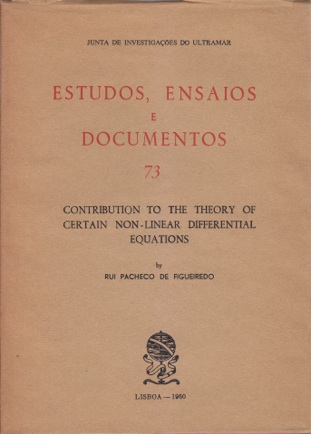
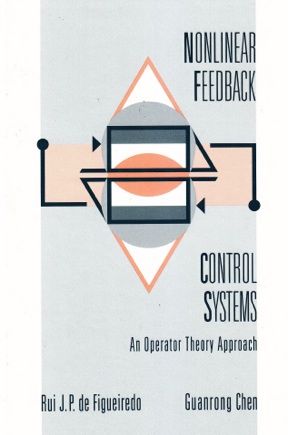
In particular, I remember we worked together on one of your most favorite research topics, to which you made major contributions, about the generalized Fock space, denoted F. I always joked with you that this F stands also for Figueiredo, which is a reproducing kernel Hilbert space of nonlinear input-output maps of generic nonlinear dynamical systems. It was your suggestion to use a “linear” orthogonal projection in F for optimal recovery of underlying “nonlinear” maps from the system input-output data, producing an elegant theory in mathematics with some successful practice in data-information processing. When we started to prepare a technical book, which summarized this generalized Fock space theory and techniques, entitled Nonlinear Feedback Control Systems: An Operator Theory Approach (Academic Press, 1993), you showed me your very first book Contributions to the Theory of Certain Non-linear Differential Equations (Lisboa, 1960), a small-sized but very valuable treatise that not many friends knew about, which impressed me very much, thus motivated me to finish and publish our coauthored book soon after I left Rice.
I left Rice in 1990, when you accepted a joint position as a Full Professor of Electrical and Computer Engineering and of Mathematics at the University of California at Irvine, where you worked also as the Director of the Laboratory for Machine Intelligence and Soft Computing of the California Institute for Telecommunications and Information Technology (Calit2), until you retired from there in 2007. You were so dedicated, enthusiastic and also energetic that, even in retirement with a new distinguished title as Above-Scale Research Professor, you continued your research activities as usual till the very last minute of your lifetime.
Rui, having said so much above, I have to confess that there are many good things about you and your past that I do not remember in detail. I do not remember exactly how many honors and awards you had received throughout your career, which were simply countless. Nevertheless, I do remember some of your notable awards, which include the IEEE Circuits ad Systems (CAS) Society Technical Achievement Award (1994), IEEE CAS Society Golden Jubilee Medal (1999), IEEE Third Millennium Medal (2000), IEEE CAS Society Mac Van Valkenburg Award (2002), and Kapitsa Medal (2009). In addition, you were elected Foreign Member of the Russian Academy of Natural Sciences (RANS) in 2007. You were awarded, again by the RANS, the 2010 Golomb-Chilingar Medal of Honor for “Giants of Science and Engineering”, in acclaim of your sustained life-long fundamental contributions to sciences and engineering and extraordinary international leadership in your profession. Last but not least, I would like to mention that you were elected IEEE Fellow in 1976 and served as the 1998 President of the IEEE CAS Society.
Rui, I also have to confess that we (a few colleagues together with nominator Prof Robert W. Newcomb from the University of Maryland) failed to name you for the forthcoming IEEE Gustav Robert Kirchhoff Award, to honor your “sustained pioneering contributions to mathematical foundations of signal and image processing and nonlinear networks; and turning them into technologies, with major impact on wide-ranging IT applications.” For one reason, we were told that traditionally it recognizes awardees who are still alive today. In our hearts, however, your legacy will live on with or without anymore official recognitions.
Dear Rui, you treated everyone with kindness, trust and respect. My clear memories about you and your glorious past will refuse to fade away. As a tiny instance I remember you were the only one that I knew who used to say “so long” when hanging up the phone. Here let me say the same to you:
“So long, Rui. May God bless you for ever!”
G Ron Chen, City University of Hong Kong (email: gchen@ee.cityu.edu.hk)