CASS Satellite Workshop on Energy-Efficient AI Architectures
Organizer: Prof. Keshab K. Parhi, University of
Minnesota Twin Cities
Sponsored by: IEEE Circuits and Systems Society
Colocated with 2026 IEEE Midwest Symposium on
Circuits and Systems
Held on: August 9, 2026
Location: Cincinnati, Ohio
The goal of the proposed workshop was to bring together experts to discuss recent advances in energy-efficient artificial intelligence (AI). AI market is expected to grow to $5T by 2033, and is expected to create 12-78 million new jobs, as per Anthropic’s 2026 AI index. There has been tremendous growth in AI over last ten years. The number of parameters in current AI models is in the range of 2-6 T, and the cost of energy consumption to train these models is in the range of $500M-$1B+. Reducing energy consumption in AI agents and data centers is one of the challenges that needs to be addressed by Circuits and Systems researchers. How can we reduce the amount of data needed to train these agents? How can we reduce energy consumption of post-training and inference-time training? What are the approaches to reducing energy consumption in design of low-rank approximation modules? The workshop speakers discussed solutions to these problems and identified future directions.
The
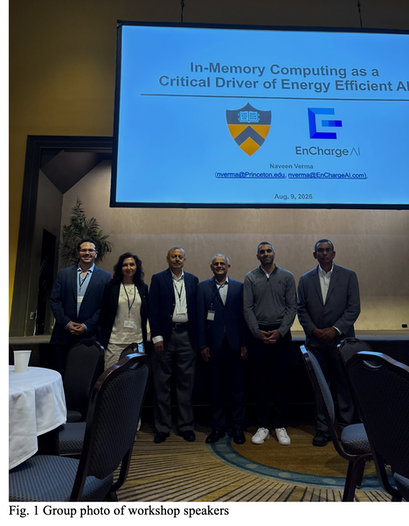
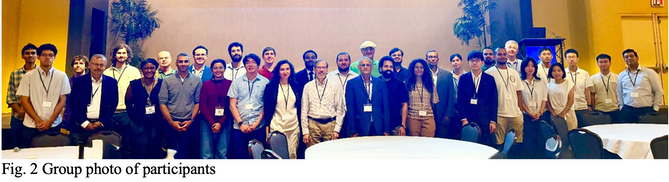
workshop was attended by about 50 participants. Photos of the workshop
attendees and the six presenters are included.
Workshop Agenda:
8:00 Registration
8:30-12:00 (includes 15 min coffee break)
- Keshab K. Parhi, University of Minnesota Twin Cities, Domain-specific Energy-efficient Artificial Intelligence Agents
- Niraj K. Jha, Princeton University, Bottom-up Domain-Specific Superintelligence
- Naveen Verma, Princeton University and EnCharge AI, Analog In-Memory Computing is a Key Driver of Energy Efficient AI Naveen Verma, Princeton University and EnCharge AI, Analog In-Memory Computing is a Key Driver of Energy Efficient AI
1:30-5:00 (includes 15 min coffee break)
- Krishnan Kailas, Independent Researcher and Entrepreneur, Beyond Efficient Accelerators: System Design Challenges for Sustainable AI
- Tinoosh Mohsenin, Johns Hopkins University, Physical AI at the Edge: Connecting Perception to Action for On-Device Autonomous Intelligence
- Hai “Helen” Li, Duke University, How Memory Powers Intelligence: From Cognition to AI Computing Systems
1. Domain-specific Energy-efficient Artificial Intelligence Agents
Keshab K. Parhi, University of Minnesota Twin Cities
Abstract: The unprecedented power of large
language models holds promise for design of artificial intelligence agents that
can demonstrate broad capabilities of intelligence, including reasoning,
planning, and the ability to learn from experience, and with these capabilities
at or above human-level (Bubeck et al., GPT-4 paper). However, the path forward
is unsustainable with respect to energy efficiency, growth in data required to
train models, and safety and security of the models. This is because the current
artificial intelligence agents are trained using correlation. We argue that
future AI agents will need to be trained using much less data by exploiting
prospective learning, as opposed to retrospective. Further reduction in energy
is achieved by reducing memory access, sparsity, quantization, mixture of
experts, fine tuning, and low-rank approximation. Other approaches include
novel compute structures such as state space models and possibly
hyperdimensional computing.
2. Bottom-up Domain-Specific Superintelligence
Niraj K. Jha, Princeton University
Abstract: The artificial
intelligence (AI) industry is currently focused on achieving general
superintelligence in a top-down fashion by training very large (trillions of
parameters) omniscient multimodal models using a large language model (LLM) as
a base. This approach is insatiably thirsty for data during training, leading
to unsustainable electricity/water costs and CO2 emissions. Even after
incurring such huge costs, these models are known to hallucinate. This makes it
difficult to employ them in domains where accuracy is important, e.g.,
medicine, law, business. We propose to take the opposite tack – build
domain-specific superintelligence bottom-up, modeled after how
superintelligence is achieved in the human society. Each of us just has human
intelligence, but a society of humans achieves superintelligence in a
particular domain in a bottom-up fashion by looking at the problem from diverse
angles. Could we build domain-specific superintelligence in the same bottom-up
fashion through a society of AI assistants and AI agents? The AI assistants
will serve as aides to experts in the field. AI agents will have more autonomy.
Such a framework would need to be accompanied by robust reasoning grounded in
verifiable facts. This means that abstraction should precede generalization.
Currently, AI agents use LLMs for reasoning. However, LLMs exhibit a very
uneven reasoning performance. Our framework will take inspiration from
neuroscience and include episodic and working memories to facilitate reasoning.
The AI assistants in the framework will be based on fine-tuned small multimodal
models, targeted at various modalities, e.g., physiological signals, medical
images, and medical text in the sphere of medicine, that can be trained
data-efficiently and are aligned with each other. In this talk, we will explore our initial
progress towards realizing this vision.
3. Analog In-Memory Computing is a Key Driver of Energy Efficient AI
Naveen Verma, Princeton University, and EnCharge AI
Abstract: After
many decades of hoping for analog computation, research and substantial
industry attempts have taught us a great deal. This talk surveys the major
findings and lessons learned, which have brought us to point of making analog,
particularly in-memory computing (IMC), a critical technology for future
energy-efficient AI systems. The insights start at the level of fundamental
tradeoffs, and drive essential implications at the device, circuit,
architectural, and algorithmic levels. This talk looks at analog IMC
specifically from the lens of practical architectures for delivering scaled-up
system-level efficiency inflections. While this bring to the forefront critical
challenges for many analog pathways, it also illuminates analog approaches that
can and are driving significant efficiency boost, as prevailing digital
trajectories are saturating. As we think about these, it is also essential to
consider how such inflections can be constructively adopted within the
increasingly complex and multi-faceted ecosystem and system requirements, and
not break the way systems are constructed today and in the future. This
requires considering architectural and software design approaches, as well as
alignment with key industrial trends.
4. Beyond Efficient Accelerators: System Design Challenges for Sustainable AI
Krishnan Kailas, Independent Researcher and Entrepreneur
Abstract: The cost of AI computation is becoming impossible to hide. As AI assistants move from experimental demonstrations to ubiquitous everyday products, the economics of training, inference serving, data movement, and user-facing quality-of-service are beginning to shape both system architecture and product deployment. Using an AI coding assistant as a motivating example, this talk will examine the end-to-end challenges of building energy-efficient AI systems, from software integration and accelerator abstraction to realistic deployment constraints.
The talk will argue that approximate computing is an enabling technology for sustainable AI, but only when considered across the full stack. Device- and circuit-level efficiency claims are insufficient if data motion, software overheads, or the lack of reusable hardware/software abstractions dominate end-to-end behavior. Why AI accelerators need better lower-level contracts comparable in spirit to CPU ISAs and virtualization interfaces, and how the absence of such abstractions limits reuse, portability, and system-level optimization will be discussed.
This talk will also revisit analog AI, questioning whether its most compelling opportunity lies not in latency- and correctness-sensitive inference, but in training. The talk will briefly highlight emerging model and computation paradigms, including weightless neural networks and logic gate networks, as examples of inference-specialized designs in which approximation, model representation, and hardware architecture can be co-designed for deployment scenarios with tight energy and latency constraints.
5. Physical AI at the Edge: Connecting Perception to Action for On-Device Autonomous Intelligence
Tinoosh Mohsenin, Johns Hopkins University
Abstract: As AI systems move beyond perception to enable real-time, reliable action in the physical world, their computational demands continue to rise due to the rapidly growing volume of data and increasingly complex algorithms required for higher-quality results. At the same time, while these systems demand energy efficiency and real-time performance, they often rely on cloud infrastructure, introducing latency, network dependence, and privacy risks.
This talk will discuss hardware-aware architectures and the co-design of algorithms and systems that enable efficient, real-time intelligence directly on-device. Metareasoning approaches that dynamically balance computation between edge and cloud to optimize real-time performance and energy efficiency will be presented. The talk will conclude with a forward-looking perspective on the opportunities and challenges in building scalable, deployable Physical AI systems that are efficient, resilient, and ready for real-world impact.
6. How Memory Powers Intelligence: From Cognition to AI Computing Systems
Hai “Helen” Li, Duke University (presented by Nicolas Ramos)
Abstract: As artificial intelligence (AI) continues to scale in power and influence, modern models increasingly mirror the complexities of human cognition. Yet, a widening gap exists between the principles of biological memory and the constraints of contemporary computing systems. This talk, How Memory Powers Intelligence: From Cognition to AI Computing Systems, explores this intersection through the lens of memory. Research that reimagines intelligent systems not just as data processors, but as experience-driven learners will be presented. Key questions include: How can systems retain and learn from past interactions? How can we prioritize what information is worth encoding? What strategies enable efficient consolidation of long-term knowledge? And how can we accelerate memory retrieval to support real-time reasoning? By drawing parallels between cognitive science and AI architecture, the talk highlights novel memory-centric approaches to unlocking more intelligent, scalable, and adaptive computing systems.
Provided by
Keshab K. Parhi, University of Minnesota Twin Cities