
EDUCATION NEWS
Sharing "Globalization Leadership Mentoring Program" Experiences at Selective Universities in Taiwan
The 21st Century presents lots of new challenges to engineers and scientists in high-tech fields such as microelectronics, information technology, multimedia, image processing, telecommunication, etc. Job out-sourcing locally to nearby service companies or globally to a different continent is one such prominent example. Extensive use of computers and automation equipment in increasing the productivity significantly alters the role of engineers in modern corporations/institutions. Governments in many countries such as Japan, Korea, Taiwan, and China have made huge extra investments in research universities in order to help them achieve first-rate excellence in higher education and global academic standing. Such investment typically leads to addition of new buildings and expensive laboratory equipment or recruiting of a few eminent people (such as Nobel Laureates, Members of National Academy of Sciences, or Members of National Academy of Engineering) to selected universities. However, direct help to the existing faculty members are usually not noticeable. Thus, a new paradigm shift in helping the existing faculty members to master the academic career in the 21st Century is urgently needed in order to realize and enhance academic excellence.
“Globalization Leadership Mentoring” Program is a new initiative undertaken by several enthusiastic researchers in the circuits and systems field in Taiwan. This new initiative was first started in 2002 as a pilot project at National Chiao Tung University in Hsin-Chu City where the world’s top IC foundries such as TSMC, Taiwan Semiconductor Manufacturing Company, and UMC, United Microelectronics Corporation, are located. Prof. Bing Sheu, who is an Honorary Professor at the university and also Program Director at TSMC, together with Professor Peter Wu and Professor Chin-Teng Lin, conducted experiments to help EECS professors in Taiwan contribute to international academic/technical societies more effectively and efficiently, for example to serve and contribute to some prominent IEEE Societies such as Circuits and Systems Society (CASS), Signal Processing Society (SPS), and Solid-State Circuits Society (SSCS). In 2004, this “Globalization Leadership Mentoring” Program was extended to National Cheng Kung University in Tainan City, Taiwan. Through this mentoring initiative, some enthusiastic and well-established professors in Taiwan have become IEEE Fellows (such as Peter Wu in 1998, Chin-Teng Lin in 2005, and Bin-Da Liu in 2006). Some of them served as the Deputy EIC of T-CAS1, Associate Editors of T-CAS, T-VLSI, CAS Magazine, Guest Editors of T-CAS1, etc. Some served as Chair or Secretary of various Technical Committees in IEEE CAS Society. Furthermore, some were successfully elected to serve as BoG Members (such as Chin-Teng Lin for 2006-08, Julia Chung for 2007-09) or Vice Presidents (such as Peter Wu as 2004/05 VP-Conferences, and Bin-Da Liu as 2005/06 VP Region-10) in IEEE CAS Society. In 2005, the Globalization Leadership Mentoring Program was further extended to help teachers and students in high schools to focus on "21st Century High-Tech Education" challenges and opportunities. One effective method is to organize Panels or Workshops with some invited talks to share their successful experiences.
A recent "Globalization Leadership Mentoring" Panel has been successfully held at the National Chiao Tung University campus on November 10, 2006, and has lasted for more than 2 hours. The attendees are with very diverse backgrounds within iEEE (with members from Circuits and Systems Society, Computer Society, Communications Society, and Solid-State Circuits Society). In addition, Dean of Academic Affairs (who is from Department of Foreign Languages and Literatures), and Dean of Engineering College (who is from Department of Civil Engineering) also participated. Three professors came from a different city. They are Profs. Bill Tai, Justin Lai, and John R. Chen of National United University in Miaoli City.
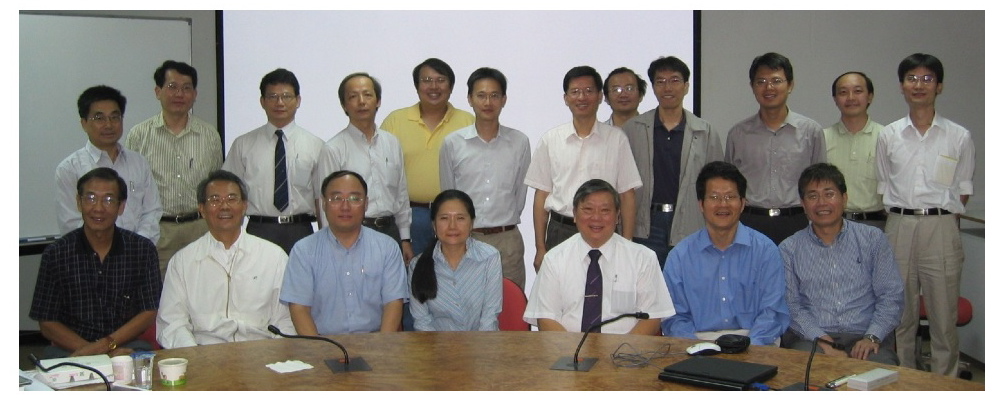
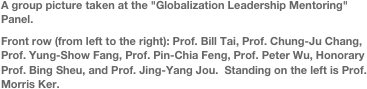
In the experience sharing part, Chair Professor Peter Wu (former ECE College Dean) gave opening remarks. He presented his valuable experience in making in-roads in global academic circles and in serving the professional communities, especially inside IEEE and also with leading research universities in the US. Notice that Peter served as a Full Professor at University of Illinois, Urbana-Champaign, during the 2003 fall semester teaching the junior-level microelectronics course to about 100 undergraduate students. Then, Professor Chung-Ju Chang (former R&D Dean) shared his experience in contributing to the Communications Society in detail. After that, Professor Jing-Yang Jou (former EE Department Chair, and currently Director of Chip Implementation Center under National Science Council) shared his unique experience in collaborating with international leaders. His research field is in electronic design automation, i.e. CAD. Also, Professor Jen-Hui Chuang (Associate Dean of the Computer Science College) to make a presentation about how to upgrade oneself in a professional society.
Then, Prof. Pin-Chia Feng (Dean of Academic Affairs) described the importance of reaching out to the global academic community and nurturing more faculty members to become global academic leaders. Professor Yung-Show Fang (Dean of Engineering College) described the enthusiasm and eagerness of Engineering College to serve the professional community and to enhance global academic standing. He would like to apply the skills learned from “Globalization Leadership Mentoring Program” directly to other engineering disciplines such as Civil Engineering or Mechanical Engineering.
Prof. Morris (Ming-Dou) Ker described his on-going efforts. He attended undergraduate study simultaneously with Prof. Chin-Teng Lin. During the past few years, Professor Lin went through global academic ladder effectively and efficiently to become a successful academic who has been recognized as IEEE Fellow and elected as BoG Member at IEEE CAS Society. Prof. Ker begins to formulate effective strategy under the mentorship of Honorary Professor Bing Sheu and Chair Professor Peter Wu. He now focuses on intelligent execution.
If a person is highly motivated with strong enthusiasm in contributing to the professional community, then even a faculty member in a second-tier teaching university can make significant in-roads toward becoming a global leader. Associate Prof. John R. Chen has been persistent in participating in Globalization Leadership endeavor since its inception. He has devoted much of his time in serving the professional community, such as being an Associate Editor for IEEE Circuits and Systems Magazine, IEEE Circuits and Devices Magazine, and IEEE Transactions on Circuits and Systems – Part I.
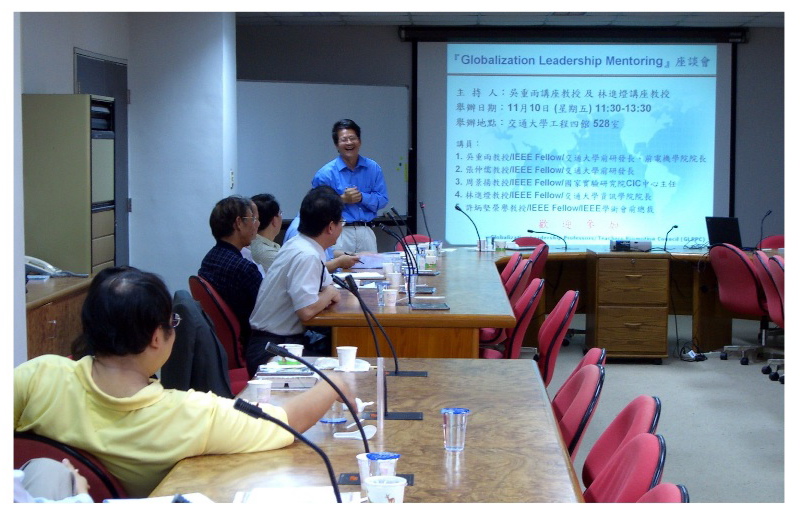 Honorary Professor Bing Sheu shared his experience from rather unexpected angles because he did not hold a regular teaching position and thus could talk outside the box very flexibly. He showed the importance of exercising true freedom in academic thinking. To interact effectively with a well-established academic leader, a researcher from Taiwan not only has to speak English fluently, but also has to understand the person's culture and, more importantly, the person’s philosophy. Any successful skill to interact with a global academic leader will therefore require some time to develop. During the Panel, due to limited time, Honorary Prof. Sheu had spent only a few minutes to summarize the salient points to catch the fundamental nature of the essence of globalization leadership. (Photo on right: Honorary Prof. B. Sheu sharing his experience)
 A proposal was prepared jointly by Bing Sheu and Morris Ker, and submitted to IEEE Circuits and Systems Society in order to provide the benefits of “Globalization Leadership Mentoring Program” to the Society members directly.
B. Sheu (Email: b.sheu@ieee.org) and M. Ker (Email: mdker@ieee.org), National Chiao-Tung University, Taiwan.

