Beyond AI: Reshaping Careers in the AI-Powered Era
WiCAS–YPCAS Joint Event at ISICAS 2025 in China
The IEEE Women in Circuits and Systems (WiCAS) and Young Professionals in Circuits and Systems Society (YPCAS) jointly hosted an inspiring professional-development event titled “Beyond AI: Reshaping Your Career in the AI-Powered Era” on October 26th, 2025, at the Qingdao Hyatt Regency. Bringing together early-career researchers, students, and established professionals, the session created a dynamic space to explore how artificial intelligence is transforming career trajectories in both academia and industry. Spanning insightful keynotes, forward-looking discussion, and open dialogue, the event advanced the Society’s mission to support inclusion, leadership, and holistic professional growth within the global CASS community.
 A
Collaborative Space for Reflection and Guidance
A
Collaborative Space for Reflection and Guidance
The event opened with welcoming remarks from Prof. Xing Wu and Prof. Yanan Sun, who emphasized why conversations about career adaptability, leadership, and human-centered skills are now more important than ever (Figure 1). Their introduction set a thoughtful tone, framing the event not simply as a set of talks but as a shared exploration of how individuals can navigate and shape an AI-accelerated future.
Figure 1 (Right). Opening remarks by Prof. Xing Wu and Prof. Yanan Sun at the WiCAS–YPCAS Joint Event
Insights from Academia and Industry
A one-hour keynote session followed, featuring perspectives from three distinguished speakers. Prof. Xing Wu (ECNU), Vice Dean at the School of Integrated Circuit Science and Engineering, shared an academic viewpoint shaped by her work in reliability and device-level characterization—offering reflections on how AI is redefining research depth, interdisciplinary collaboration, and the evolving skill sets expected from young scholars. Prof. Jiamin Li (SUSTech), an expert in energy-efficient biomedical microsystems and neuromodulation, discussed the opportunities created by AI-accelerated medical technologies and highlighted how early-career researchers can navigate cross-domain innovation. Dr. Shulin Zeng (Infinigence AI), General Manager and Head of Hardware Design, presented an industry-centered perspective on software–hardware co-design and AI accelerator development. He stressed the rising importance of systems thinking, agility, and fluency in AI-augmented workflows.
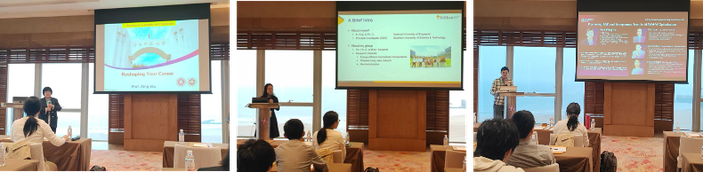
Figure 2. Keynote speakers Prof. Xing Wu (ECNU), Prof. Jiamin Li (SUSTech), and Dr. Shulin Zeng (Infinigence AI)-from left to right
Together, their talks did more than outline trends — they encouraged attendees to consider what unique strengths people bring to an increasingly automated world, and how early-career engineers can craft identities that complement rather than compete with AI tools.
Roundtable: Skills, Leadership, and High-Value Opportunities in the AI Era
As the session transitioned into the roundtable discussion, Prof. Hua Fan (UESTC) joined the speakers on stage, enriching the conversation with additional academic and leadership insights. The panel examined three forward-looking topics:
- How AI is augmenting careers in both academia and industry – Panelists shared concrete examples of how AI tools now accelerate literature exploration, code verification, design automation, and hypothesis generation, shifting human efforts toward higher-level reasoning and creativity.
- Must-have skills for staying competitive – Discussions centered on hybrid expertise (circuits + data + systems), communication, interdisciplinary collaboration, and human-centric leadership as essential differentiators for young professionals.
- High-value skills that complement AI – Panelists encouraged attendees to cultivate strengths that AI cannot replace: problem framing, ethical judgment, mentorship, strategic decision-making, and meaningful community engagement.
The dialogue was warm, candid, and at times deeply personal. Panelists reflected on their own growth, missteps, shifts in direction, and the evolving meaning of success. Audience members, many of whom were graduate students or young professionals navigating similar crossroads, resonated strongly with these stories. Nods, laughter, and moments of quiet reflection filled the room — the kind of atmosphere that signals genuine connection rather than a formal academic session.
By the end of the discussion, the event had accomplished more than its agenda suggested. It created a shared understanding: that the future of engineering will require not only technical excellence but adaptability, community, purpose, and the confidence to evolve.
As participants stayed afterward to continue conversations informally, the energy in the room made clear that WiCAS and YPCAS had delivered more than a program — they had fostered belonging. The organizers extend their gratitude to the speakers, the local team, and IEEE CASS for supporting initiatives that center humanity within technological progress.
Special thanks are extended to Prof. Xing Wu, Prof. Jiamin Li, Dr. Shulin Zeng, and Prof. Hua Fan for their contributions; to the local organizing team for logistics and coordination; and to IEEE CASS for its continued support of diversity, mentorship, and professional excellence.
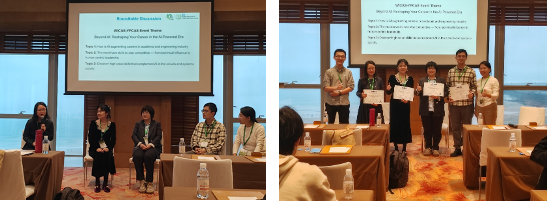
Figure 3. Panel discussion featuring Prof. Hua Fan alongside keynote speakers (left) and speakers gathering after the session (right)
Reported by Bokyung Kim