Empowering Career Development and Inclusion:
WiCAS and YPCAS Events at LASCAS 2026
The IEEE Circuits and Systems Society (CASS) Women in Circuits and Systems (WiCAS) and Young Professionals in Circuits and Systems (YPCAS) initiatives were prominently featured during the 17th IEEE Latin American Symposium on Circuits and Systems (LASCAS 2026), held from February 25 to 27, 2026, in Arequipa, Peru. These events provided engaging and inclusive platforms for students, early-career researchers, and professionals to explore career development, leadership, and opportunities within the Circuits and Systems community.
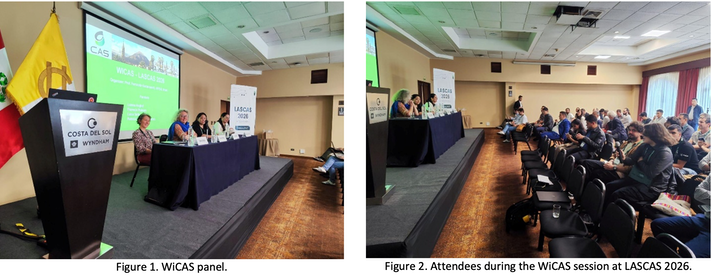
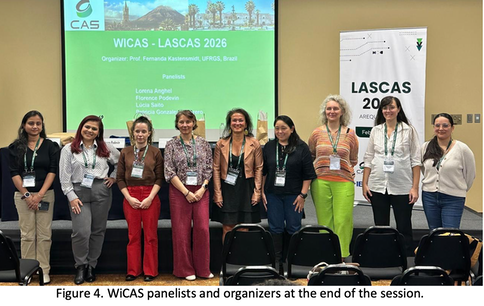
The WiCAS session, held on February 25, brought together more than 60 participants from Latin America, North America, Europe, and Asia in an inspiring and interactive environment (Fig. 1). Organized by Prof. Fernanda Lima Kastensmidt (Federal University of Rio Grande do Sul, Brazil), the session focused on the theme “Women in Engineering: Different Pathways to Success.” The panel featured Patricia Gonzalez-Guerrero (Lawrence Berkeley National Laboratory, USA), Florence Podevin (Grenoble INP, France), Lucia Akemi Miyazato Saito (Mackenzie Presbyterian University, Brazil), and Lorena Anghel (Grenoble INP, France), who shared their experiences across different career stages and research areas.
The session combined short presentations with open discussion and networking opportunities, fostering a dynamic exchange between speakers and attendees (Fig. 2). Key topics included career decision-making, strategies to overcome unconscious bias, and the importance of mentoring, networking, and leadership. Panelists emphasized the role of diversity and inclusion in driving innovation and highlighted the importance of building supportive professional communities.
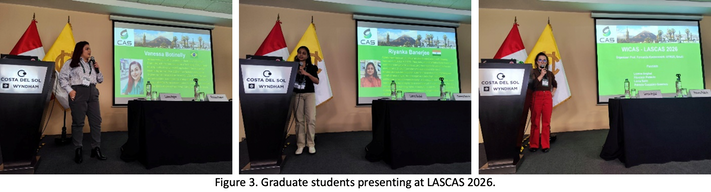
A particularly meaningful moment of the event was the involvement of graduate students presenting at LASCAS 2026, who were invited to introduce themselves and connect with the audience (Fig. 3). This initiative increased visibility and confidence among young researchers. The session concluded with strong audience engagement, with participants appreciating the openness of the discussions and the opportunity to interact directly with the speakers (Fig. 4).
The YPCAS session, held on February 27, focused on supporting early-career professionals by offering insights into career development and emerging opportunities in the field. The panel included Víctor Grimblatt (Synopsys, Chile), Manuel Monge (OpenIC, USA), Josie E. Rodriguez Condia (Politecnico di Torino, Italy), Juan-David Guerrero-Balaguera (Politecnico di Torino, Italy), and Jimmy Tarrillo (Universidad de Ingeniería y Tecnología—UTEC, Peru), and was moderated by Mario Raffo (Pontificia Universidad Católica del Perú, Peru).
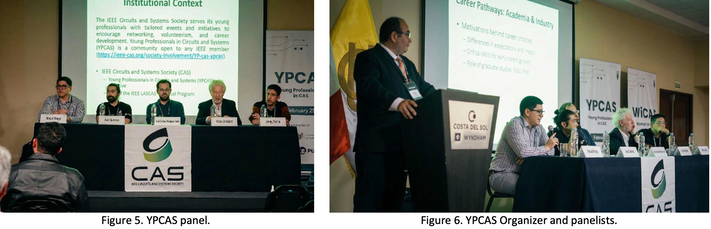
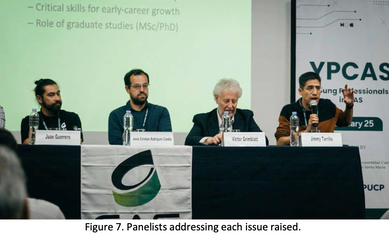
The discussion brought together perspectives from both academia and industry, providing attendees with a comprehensive overview of career pathways and professional growth opportunities (Fig. 5 and Fig. 6). Panelists addressed topics such as academic versus industrial careers, the role of graduate education, and the importance of visibility through research and participation in international communities. They also highlighted the value of engagement in IEEE activities for developing leadership skills and expanding professional networks.
In addition, the panel explored emerging technological trends, including artificial intelligence hardware, energy-efficient computing, and innovation opportunities within the Latin American ecosystem. These discussions emphasized the importance of adaptability and interdisciplinary skills in a rapidly evolving technological landscape.
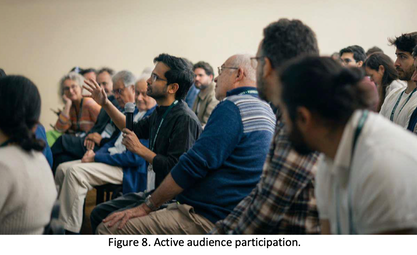
The session concluded with an interactive question-and-answer segment, during which participants actively engaged with the panelists on topics such as career planning, international mobility, and research collaboration (Fig. 7 and Fig. 8). The strong participation reflected the high level of interest in professional development within the community.
Overall, the WiCAS and YPCAS events at LASCAS 2026 successfully created meaningful opportunities for exchange, mentorship, and community building. By bringing together participants at different career stages and from diverse backgrounds, these initiatives reinforced the importance of inclusive environments that support both professional and personal growth. The authors would like to thank the IEEE Circuits and Systems Society and the LASCAS 2026 organizers for their support, and the DEICAS Committee for its guidance in shaping the program and promoting diversity, equity, and inclusion within the community.
Reported by
Giulia Di Capua, DEICAS Chair, IEEE CASS, University of Cassino and Southern Lazio, Italy
Fernanda Lima Kastensmidt, LASCAS 2026 WiCAS Chair, Federal University of Rio Grande do Sul, Brazil
Mayte Giraldo, LASCAS 2026 WiCAS Organisational Support, Pontificia Universidad Católica del Perú, Perú
Mario Raffo Jara, LASCAS 2026 YPCAS Chair, Pontificia Universidad Católica del Perú, Perú
_________________________________
DEICAS-WiCAS-YPCAS Session at 2025 ICECS
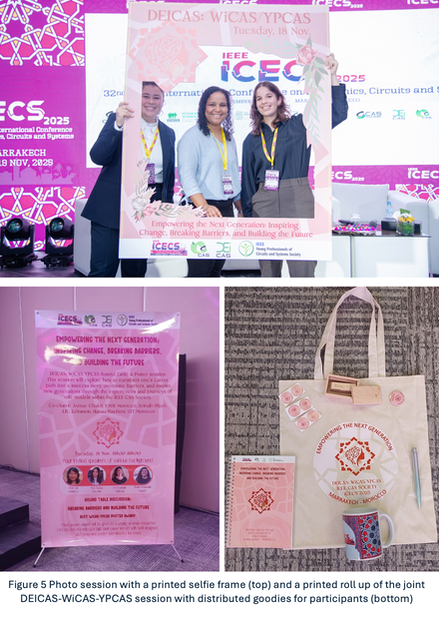
DEICAS: WiCAS/YPCAS session “Empowering the Next Generation: Inspiring Change, Breaking Barriers, and Building the Future” successfully held at IEEE ICECS 2025
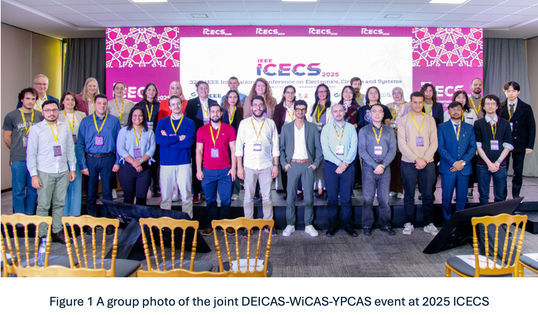
The IEEE Diversity, Equity, and Inclusion in Circuits and Systems (DEICAS), Women in Circuits and Systems (WiCAS), and Young Professionals in Circuits and Systems (YPCAS) initiatives successfully organized a joint event titled “Empowering the Next Generation: Inspiring Change, Breaking Barriers, and Building the Future” during the IEEE International Conference on Electronics, Circuits and Systems (ICECS 2025), held in Marrakech, Morocco, on November 18, 2025. The session provided an engaging platform for discussions on leadership, inclusion, and career development in circuits and systems, bringing together participants from academia, industry, and research communities.
Co-organized by Asmae Chakir (EMSI, Morocco), Zeinab Hijazi (Lebanese International University, Lebanon), and Hanaa Hachimi (Ibn Tofail University, Morocco), the event fostered an inclusive and inspiring environment for young professionals, students, and researchers. The program consisted of two main components: a round table discussion and an interactive poster session, designed to encourage dialogue, mentorship, and collaboration across diverse backgrounds.
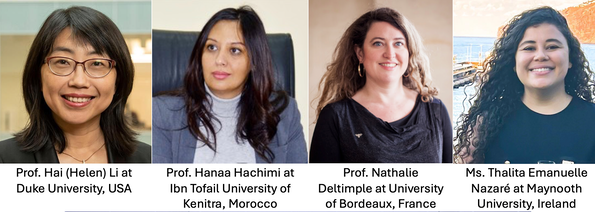
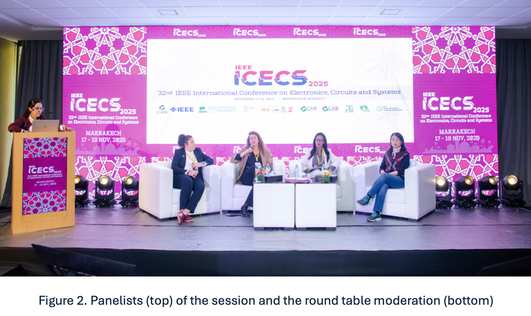
The event opened with a dynamic round table session featuring distinguished panelists: Profs. Hai (Helen) Li, Hanaa Hachimi, Nathalie Deltimple, and Ms. Thalita Emanuelle Nazaré. Moderated by Asmae Chakir, the discussion addressed key topics such as navigating academic versus industry career paths, developing critical skills in AI and sustainability, overcoming barriers in STEM—particularly for women—and fostering effective communication and leadership within engineering teams. Panelists also shared personal experiences and practical advice, inspiring attendees to build impactful and resilient careers.
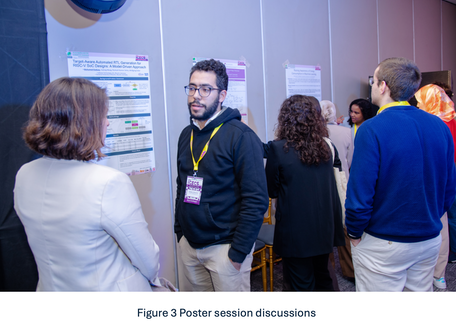
Following the panel, the poster session showcased innovative research contributions from early-career researchers and students. Selected participants presented short, impactful posters covering a range of topics including hardware design, sustainable computing, TinyML, RF circuits, and embedded systems. The session emphasized clarity, innovation, and real-world relevance, providing valuable opportunities for interaction between presenters and senior experts.
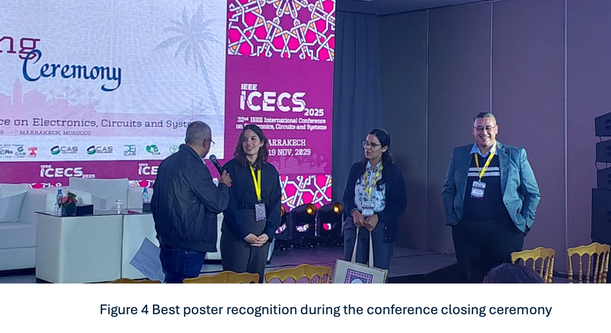
The event concluded with recognition of outstanding contributions through the Best Poster Award, presented during the conference closing ceremony. Notably, Anna Mylona received the award for her work on an analog hardware-based edge detector for biomedical applications. All participants were acknowledged for their contributions, reinforcing the event’s mission to support and celebrate emerging talent in the circuits and systems community.
The DEICAS, WiCAS, and YPCAS co-chairs extend their sincere appreciation to the IEEE Circuits and Systems Society (CASS) and the ICECS 2025 organizing committee for their generous support. This joint initiative highlights the Society’s continued commitment to diversity, inclusion, and the professional growth of the next generation of researchers and engineers.
Reported by
Bokyung Kim